The CIA Triad: Explaining the Three Pillars of InfoSec
Every security control exists to protect one of three things: who gets access to your data, whether that data stays trustworthy, and whether your systems are available when people actually need them. Those three principles, namely Confidentiality, Integrity, and Availability make up the CIA triad which is the foundation behind almost every security policy you'll encounter.
The financial impact of security incidents alone makes the model worth understanding. IBM's 2025 Cost of a Data Breach Report puts the global average cost of a breach at $4.44 million. Before you can defend a system effectively, you need to know which of the three pillars an attack is trying to break.
What Is the CIA Triad?
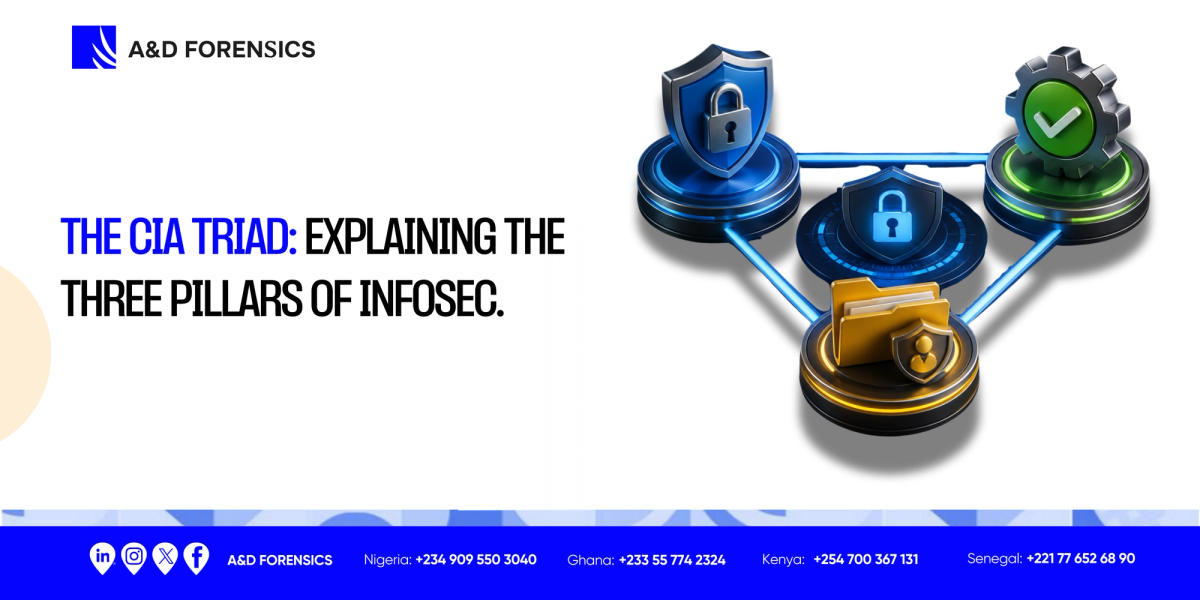
The CIA Triad is a model you can use to guide your security policies and defences. It consists of three core principles:
- 1.Confidentiality :Keeping data private and accessible only to authorized people
- 2.Integrity : Keeping data accurate, consistent, and trustworthy
- 3.Availability : Keeping data and systems accessible when you need them
Think of it as a three legged stool. Remove any one leg, and the whole thing topples over. Your goal isn't to maximize one pillar, it's to balance all three based on what you actually need.
Confidentiality
Confidentiality is about preventing unauthorized access to your sensitive information. This is probably the pillar you think of first when you hear "security" , it's about keeping your ‘secrets’ secret.
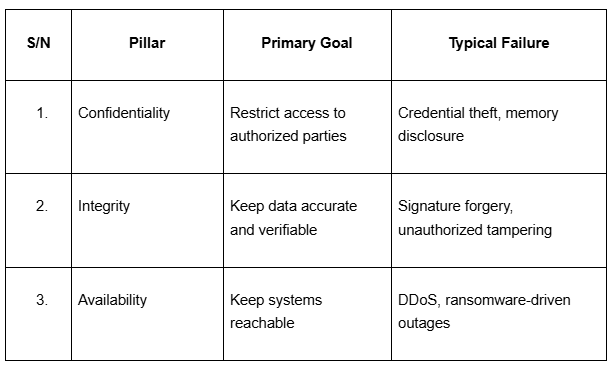
The classic Heartbleed bug (CVE-2014-0160) remains the clearest confidentiality failure on record.A flaw in OpenSSL's TLS heartbeat implementation allowed attackers to pull up to 64KB of server memory with every request. That memory could contain private keys, credentials, session cookies, or anything else sitting in process memory. The vulnerability didn't modify data or crash systems. It simply exposed information that should never have left the server.
The lesson still holds today. IBM found that customer PII appeared in 53% of breaches analyzed, making confidentiality the pillar attackers compromise most often.
How to Ensure Confidentiality:
- 1.Encryption : Scramble your data so it's unreadable without the right key, both at rest and in transit.
- 2.Access controls : Ensure only authorized users can view specific data.
- 3.Multi-factor authentication (MFA): Add layers beyond just a password.
- 4.Data classification: Label your information by sensitivity level so you handle it appropriately.
Integrity
If confidentiality answers who can read the data, integrity answers a different question: Can you trust what you're looking at?
Integrity means you can trust that your data is accurate, complete, and hasn't been altered by unauthorized parties whether that's a malicious hacker, a buggy application, or your own honest mistake.
One of the best real-world examples of attack against integrity is CVE-2026-48558, a critical flaw in SimpleHelp's remote access software. The flaw lived inside SimpleHelp's OIDC authentication flow and allowed attackers to forge identity tokens by abusing improper signature validation. As a result, unauthenticated attackers could appear to be legitimate, fully authenticated technicians. That's dangerous because once a system can't tell a forged identity from a real one, one of the core trust mechanisms in modern computing starts to fall apart.
How to Ensure Integrity:
- 1.Hashing : Generate a unique fingerprint of a file so you can detect any change.
- 2.Checksums and digital signatures : Verify your data hasn't been tampered with.
- 3.Version control : Track changes so you can detect and roll back unauthorized edits.
- 4.Audit logs : Record who changed what, and when it was changed.
Availability
A secure system isn't very useful if nobody can reach it. Availability focuses on keeping services online despite hardware failures, software bugs, or deliberate attacks.
CVE-2024-3721, actively exploited as of recent by the Nexcorium botnet campaign, shows you just how large availability attacks have become. Attackers are hijacking outdated, unpatched DVR devices with hundreds of thousands deployed worldwide and quietly folding them into a botnet. That botnet then floods targets with traffic until the target's servers can't keep up, while the hijacked devices keep recording footage normally, giving no obvious sign they've been compromised.
Availability attacks are no longer edge cases. IBM found denial-of-service activity involved in nearly 13% of the breaches they studied.
How to Ensure Availability:
- 1.Redundancy: Set up backup servers, failover systems, and geographically distributed data centers.
- 2.Regular backups : So you can restore data after an incident.
- 3.DDoS protection: Filter malicious traffic before it overwhelms your systems.
- 4.Disaster recovery planning : Document processes so you can get back online quickly.
Why You Can't Maximize All Three Pillars at Once
Here's where security becomes a balancing act.
You can lock down a system with multiple approval steps, aggressive authentication policies, and restrictive access controls. That improves confidentiality, but it can also slow legitimate users and reduce availability. Push too hard toward uninterrupted uptime, and you may delay patches or relax controls that protect confidentiality and integrity.
There isn't a universal answer because the priority depends on the system you're protecting. For example, a patient monitoring platform in a hospital can tolerate very little downtime, making availability the dominant concern, while a law firm's document repository has a much stronger case for prioritizing confidentiality over everything else.
Building a Security Program Based on the CIA Triad
A practical security program starts by tying every security control back to one of the three pillars in the CIA triad. You can build a security program based the CIA triad by:
- 1.Classifying data according to sensitivity so confidentiality controls reflect actual business risk.
- 2.Hashing and monitoring critical files so integrity violations become visible instead of remaining silent.
- 3.Testing backups regularly. Plenty of organizations verify that backups exist but never confirm they can actually restore them.
- 4.Mapping each security control to a CIA pillar during risk assessments. Doing this makes it much easier to spot gaps or investments that overlap unnecessarily.
- 5.Reviewing third-party access on a schedule. Supply-chain incidents continue to affect both confidentiality and integrity, and trusted vendors often become the weakest link.
Conclusion
The CIA triad isn't a compliance checkbox, It's a mental model behind almost every security decision you'll make. The CIA Triad because it describes the three dimensions along which you must defend your information. You can't skip any pillar. If you lose confidentiality, your data gets exposed. If you lose integrity, your data gets corrupted. If you lose availability, your business stops operating.
Once you understand the CIA Triad, you have a language for security. You can evaluate risks systematically, design defenses coherently, and communicate about security with clarity. Whether you're building a system, responding to an incident, or assessing a compliance requirement, you can use the CIA Triad as your framework to get it right.
How A&D Forensics Can Help You Find Out Which Pillar Is Weakest in Your Systems
A&D Forensics' Vulnerability Assessment and Penetration Testing (VAPT) services simulate real-world attack paths across all three pillars, helping you identify weaknesses before an attacker does. If an incident has already occurred, our security assessment team can determine what was exposed, what was altered, and what systems were taken offline giving you the evidence you need to recover with confidence.