
Comprehensive Overview of the FAFT June 2026 Plenary Meeting
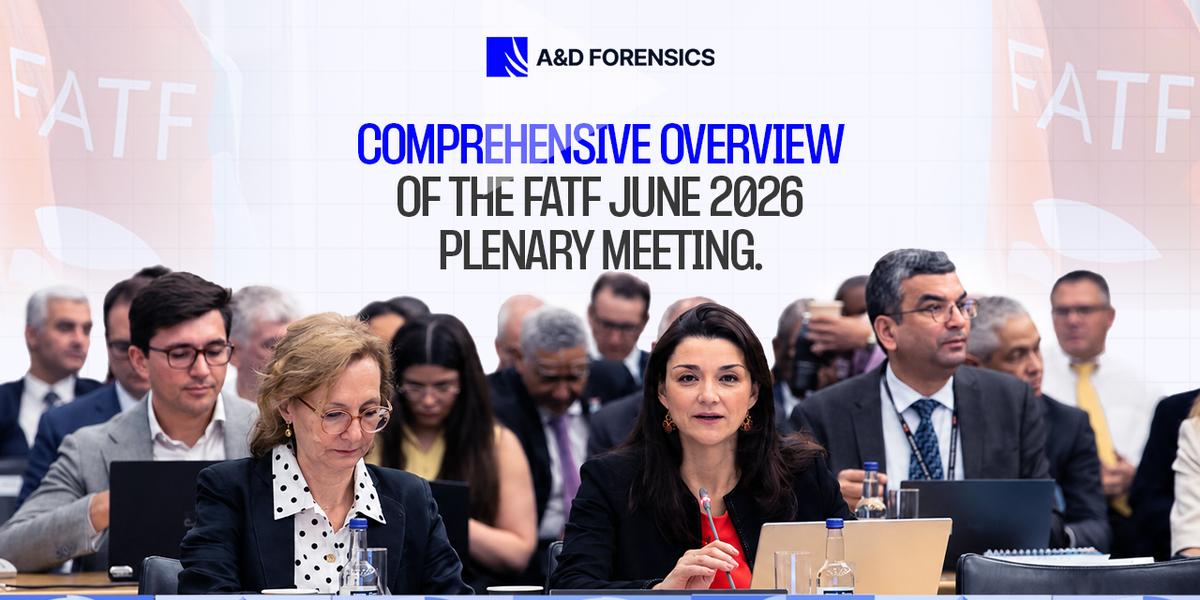
The Financial Action Task Force (FATF) June 2026 Plenary held in Paris from 17 to 19 June 2026 concluded with a comprehensive range of initiatives designed to bolster the global fight against illicit finance. Delegates from across the FATF's Global Network of more than 200 jurisdictions and observers gathered to discuss evolving threats to global financial integrity and security.
This marked the sixth and final Plenary meeting under the Mexican Presidency of Elisa de Anda Madrazo, making it a landmark session that not only produced meaningful policy updates but also marked a significant leadership transition for the organisation. For compliance officers, financial institutions, crypto firms, and regulators worldwide, the outcomes of this meeting carry immediate and far-reaching implications.
FATF JUNE 2026 UPDATES ON BLACK LIST AND GREY LIST
The FATF Black List
The FATF black list remains unchanged, covering Iran, North Korea, and Myanmar. These three countries continue to face the most severe international financial restrictions. The organisation urged all member states to apply intensive countermeasures and enhanced due diligence protocols to safeguard the international financial network from the pervasive fraud and state-sponsored financial crimes originating from these high-risk jurisdictions.
Addition to the FATF Grey List
On 19 June 2026, the FATF added Iraq and Bosnia and Herzegovina to its grey list after identifying strategic deficiencies in their anti-money laundering, counter-terrorist financing, and counter-proliferation financing frameworks. These countries have committed to action plans to address these strategic deficiencies within agreed timeframes.
Removal from the FATF Grey List
Algeria and Namibia were removed from the grey list after successful on-site visits confirmed they had completed their action plans. Algeria will continue working with its FATF-style regional body, MENAFATF, and Namibia with ESAAMLG, to sustain the improvements made.
It is also worth noting that at the June 2026 Plenary, the FATF made the initial determination that Bulgaria, Côte d'Ivoire, and the Democratic Republic of Congo have each substantially completed their respective action plans and now warrant on-site assessments to verify that their AML/CFT reforms have been implemented and are being sustained. This signals that these countries may be on course for removal from the grey list at a future Plenary.
Joint FATF: APG Mutual Evaluation of Canada and FATF Mutual Evaluation of Türkiye
The Plenary discussed and adopted reports of the joint FATF–Asia/Pacific Group (APG) mutual evaluation of Canada and the FATF mutual evaluation of Türkiye. These reports assessed the effectiveness of each country's measures to combat money laundering, terrorist financing, and proliferation financing, and compliance with the FATF Recommendations. The reports will be published in September–October 2026 following a Global Network quality and consistency review.
Beyond technical compliance, recent mutual evaluations and the new round of assessments place greater weight on how successfully jurisdictions implement the FATF Recommendations in practice. Countries are being judged not only on whether they have AML/CFT frameworks in place, but also on whether those frameworks produce results.
The New FATF Leadership Transition
This Plenary was the final one under Mexico's Presidency of Elisa de Anda Madrazo. The United Kingdom will take over from 1 July 2026, with Giles Thomson serving as the incoming FATF President.
The UK Presidency's priorities will focus on fraud, the risk-based approach, and information sharing. A new Vice-President was also appointed: Vivek Aggarwal of India, who will serve from July 2026 to June 2027.
The UK Presidency will focus on stepping up the international response to the fraud epidemic, including the money laundering and terrorist financing risks from scam compounds, strengthening implementation of the risk-based approach and risk-based supervision, and improving international information sharing in an era of increasingly digitalised and fragmented financial transactions.
Key Outcomes of the FATF June 2026 Plenary
Beyond the grey list changes and leadership transition, the June 2026 Plenary produced several important policy outcomes:
1. Update to FATF Recommendation 6
Recommendation 6 was updated so that targeted financial sanctions standards now incorporate the humanitarian exemption contained in UN Security Council Resolutions 2664 and 2761, ensuring that sanctions do not block humanitarian assistance and basic human needs.
2. Virtual Assets and DeFi
The Plenary approved a seventh targeted update on the implementation of the FATF Standards on Virtual Assets (VAs) and Virtual Asset Service Providers (VASPs). With the growth of Decentralised Finance (DeFi) platforms and their potential exposure to money laundering, terrorist financing, and proliferation financing risks, a new targeted report will also look at related regulatory challenges. These reports will be published the following month.
A public consultation was approved on guidance to implement the strengthened cross-border payment transparency standard, an area of growing importance as payment systems become increasingly fragmented and digital.
4. Global Information Sharing The Plenary approved a new Global Overview of Public and Private sector information sharing mechanisms, recognising that greater collaboration is vital to improving effectiveness against money laundering, terrorism financing, fraud, and other financial crimes in an era of increased digitalisation.
How the FATF June 2026 Plenary Affects Finance and Crypto Firms
The outcomes of the June 2026 Plenary have direct and immediate implications for banks, payment providers, fintech companies, and cryptocurrency exchanges.
1. Customer Due Diligence and Country Risk UAE financial institutions, DNFBPs, and VASPs should feed the grey list changes into their country risk assessments, enterprise-wide risk assessments, screening systems, and due diligence processes using a risk-based approach, without indiscriminate de-risking. The same principle applies to all regulated firms globally. Firms with clients or counterparties in Iraq and Bosnia and Herzegovina must now apply enhanced due diligence, while those with exposure to Algeria and Namibia can reassess downward where appropriate.
2. Virtual Asset Service Providers (VASPs)For banks, payment providers, and cryptocurrency exchanges, the latest update reinforces that AML compliance remains a moving target. The new report on virtual assets and DeFi signals that regulators are paying close attention to decentralised platforms, and VASPs should expect heightened scrutiny around transaction monitoring and Travel Rule compliance under the incoming UK Presidency.
3. Mutual Evaluation Ripple Effects
Nations failing to meet international benchmarks often suffer severe, long-lasting economic consequences, including defensive de-risking by large correspondent banks, increased international transaction friction, elevated borrowing costs, and a sharp reduction in foreign direct investment inflows. Firms operating in or with grey-listed jurisdictions must factor these realities into their risk frameworks.
4. Fraud and Sanctions ComplianceThe UK Presidency's stated focus on the global fraud epidemic and scam compounds means that financial institutions should expect new FATF guidance on fraud-related money laundering risks. The update to Recommendation 6 also clarifies that while sanctions compliance remains essential, it should not inadvertently block legitimate humanitarian transactions.
Conclusion
The FATF June 2026 Plenary reinforced the organization's commitment to ensuring that global AML/CFT frameworks remain effective, proportionate, and responsive to evolving financial crime threats. Through updates to international standards, continued scrutiny of jurisdictions with strategic deficiencies, and renewed focus on emerging risks such as virtual assets and fraud, the FATF emphasized that protecting the integrity of the global financial system requires international cooperation, risk-based supervision, and practical, measurable outcomes.
You can find previous FATF Plenary coverage from A&D Forensics here:
Contributor: Ademola-Adesola Ifeoluwaposimi