A Simple Guide to SOAR in Cybersecurity
Security teams today are not failing because of a lack of skill. They are failing because of volume. According to an article from Microsoft, organizations now receive an average of 2,992 security alerts daily, yet 63% go unaddressed. That gap between what gets flagged and what gets investigated is precisely where breaches begin. Security Orchestration, Automation, and Response (SOAR) was built to close that gap.
What Is SOAR?
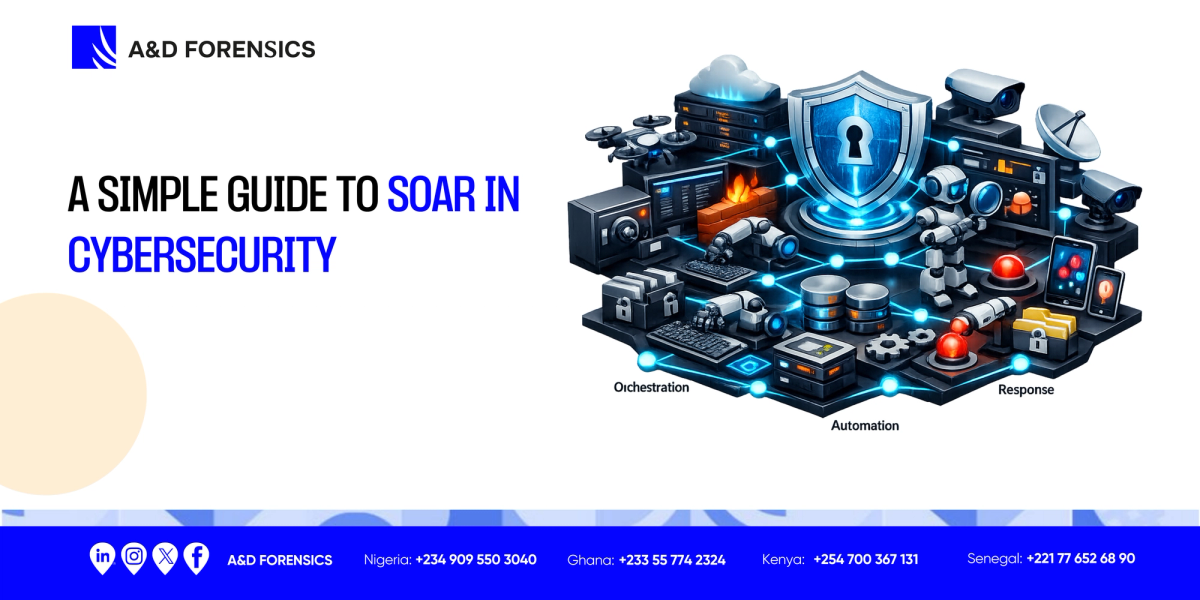
SOAR is a stack of compatible software programs that enables an organization to collect data about cybersecurity threats and respond to security events with little or no human assistance. It is built on three core pillars:
- Security Orchestration — a means of interconnecting otherwise disparate security tools so that actions can be centralized and propagated. Your SIEM, EDR, firewall, and threat intelligence feeds stop operating in isolation and begin working as a coordinated unit.
- Security Automation — security automation ingests and analyzes data and creates repeated, automated processes to replace manual ones. Routine tasks such as alert triage, IP enrichment, and ticket creation execute without analyst intervention.
- Incident Response — when a threat is confirmed, SOAR executes predefined actions based on structured workflows called playbooks, ensuring consistent, repeatable outcomes regardless of who is on shift.
According to Gartner, a complete SOAR product relies on three core capabilities to do its job: managing threats and vulnerabilities, responding to security incidents, and automating security operations.
Why Your Organization Needs SOAR
Alert fatigue is not a perception problem, it is a measurable operational crisis. The SANS 2025 SOC Survey confirms that 66% of teams cannot keep pace with incoming alert volumes. The human cost is equally significant: 71% of SOC analysts experience burnout, and 64% are considering leaving their roles within a year.
SOAR directly addresses this by reducing your Mean Time to Respond (MTTR) and enabling your team to focus on high-fidelity threats.
How SOAR Works in Practice
Consider a phishing email reported by an employee. Without SOAR, an analyst manually extracts indicators, checks threat intelligence, queries logs, and decides on a containment action all while the alert queue grows.
With SOAR, a playbook triggers automatically:
- 1.The reported email is ingested and parsed for indicators (URLs, IPs, sender domains)
- 2.Threat intelligence feeds are queried automatically
- 3.Matching malicious indicators are blocked across integrated tools
- 4.The affected mailbox is quarantined
- 5.A case is created in your incident management platform
- 6.The analyst is notified with full context already assembled
SOAR playbooks streamline the earliest stages of incident response by automatically handling alert intake and prioritization, correlating related signals to reduce duplication and noise.
What SOAR Integrates With
SOAR derives its value from the breadth of tools it connects. Common integrations include:
- SIEM platforms; Splunk, Elastic SIEM
- Endpoint detection and response (EDR): CrowdStrike Falcon
- Threat intelligence platforms; MISP, threat intel feeds
- Case management systems; TheHive, Jira
- Network security tools; firewalls, IDS/IPS
SOAR platforms use APIs to connect with SIEMs, EDRs, threat intel feeds, and other platforms to enrich alerts and trigger contextual, automated responses.
Who Benefits Most from SOAR?
SOAR delivers the greatest return for organizations with an active SOC, a high daily alert volume, or operations within regulated industries such as financial services. The SOAR market is projected to grow from $1.9 billion in 2026 to $5 billion by 2035 , a trajectory that reflects how critical automated response has become to modern cybersecurity strategy.
Conclusion
SOAR does not replace your analysts. It removes the tasks that prevent them from doing meaningful work. By connecting your security stack, automating repetitive processes, and codifying your incident response workflows into consistent playbooks, SOAR transforms your SOC from a reactive team into a proactive one. The organizations that contain breaches fastest are not the ones with the largest teams. They are the ones with the most disciplined automation.
How A&D Forensics Can Help You
A&D Forensics specializes in Vulnerability Assessment and Penetration Testing (VAPT) and incident investigation, helping organizations identify security gaps before attackers do and respond decisively when incidents occur. We also provide expert consultation to help you design, implement, and optimize security operations programs from SOAR deployment and playbook engineering to full-scale incident response and data recovery. Reach out to our team today.