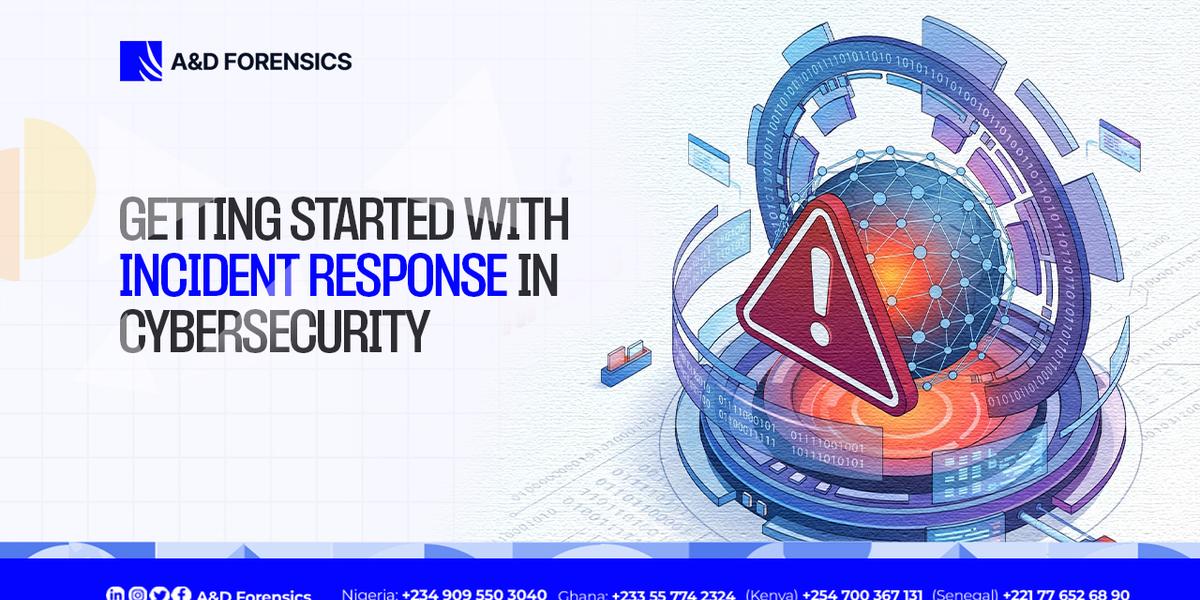
GETTING STARTED WITH INCIDENT RESPONSE IN CYBERSECURITY
Incident response is not optional as cyberattackers do not discriminate. Whether you run a startup, a hospital, a law firm, or a financial institution, the question is no longer if you will face a cyber incident but when. The global average cost of a data breach is already at $4.88 million in 2026, yet most organizations still cannot respond effectively when one hits. Building this capability is not a luxury for enterprise security teams. It is a basic operational requirement.
What Is an Incident Response?
An Incident Response (IR) is the structured process your organization follows to detect, contain, investigate, and recover from a cybersecurity incident such as a ransomware attack, unauthorized access, data exfiltration, phishing compromise, insider threats and so on.
A working IR program answers four questions when things go wrong:
- What happened, and when did it start?
- Which systems and data were affected?
- How did the attacker get in?
- What do you do now to contain and remove the threat?
Without a documented and tested process, your team improvises under pressure. That improvisation is slow, expensive, and often extends the damage.
Why Incident Response Directly Protects Business Goals
Many organizations still treat IR as something that lives inside the security team. It does not and its consequences land squarely on finance, legal, and operations.
It takes an average of 258 days to detect and contain a breach which is nearly nine months of undetected exposure. During that window, attackers exfiltrate records, establish continuous access, and move laterally across your infrastructure freely. According to the IBM Cost of a Data Breach Report, you can drastically reduce both the financial and operational impact of a breach with proactive incident response measures. By optimizing your IR through automation and expert workflows, you achieve significant resilience.
The regulatory side adds another layer. Frameworks like GDPR, NDPA, and PCI-DSS all require documented IR procedures. Miss a mandatory notification window or fail to respond appropriately, and the fine alone can exceed what the incident itself cost you.
The Incident Response Lifecycle: A Step-by-Step Overview
The two most widely adopted IR frameworks are NIST SP 800-61 and the SANS PICERL model. Both follow the same core sequence.
1. Preparation
This is the most important phase and the most commonly neglected. In this phase,you build your IR team, define roles, document communication protocols, deploy detection tools, and write response playbooks. You also identify your assets; the systems and data most critical to operations before an attacker does it for you.
2. Identification
When your monitoring tools generate alerts, this phase is where your team triages them to confirm whether a real incident has occurred. The core tools here are SIEM platforms like Splunk or the ELK Stack, EDR solutions, and network traffic analyzers like Zeek.
3. Containment
Once you confirm an incident, you stop it from spreading. Short-term containment might mean isolating an endpoint or blocking a malicious IP. Long-term containment involves patching the exploited vulnerability and hardening the systems around it.
4. Eradication
In this phase, you focus on removing the threat entirely; delete the malware, close the backdoors, disable compromised accounts, patch what was exploited. According to deepStrike the top initial infection vectors in IR investigations are vulnerability exploitation (33%), stolen credentials (16%), and email phishing (14%). Each of those requires a completely different removal playbook. Treating them the same is how you miss something.
5. Recovery
Systems come back online from clean, validated backups. This phase requires close coordination between your security, IT, and business continuity teams. Speed matters, but confirming you are restoring clean systems matters more.
6. Lessons Learned
In this phase, you run the post-incident review. Document what happened, how the response held up under pressure, and where the gaps exposed themselves. That feeds directly back into preparation which is exactly where it belongs. Every incident handled properly makes the next one faster and cheaper. Every incident handled poorly just raises the cost of the one after that.
How to Get Started with Incident Response
You don't need a massive budget or a fully staffed SOC to build an effective IR program. What you actually need is structure, clarity on roles, and the discipline to actually test what you build. Here's where to start:
- Form your IR team and define roles. Identify who handles detection, who makes containment decisions, who communicates with leadership, and who engages external support. Ambiguity during a live incident costs time you do not have.
- Document your response playbooks. Write step-by-step procedures for your most likely scenarios; ransomware, phishing compromise, credential theft, and unauthorized access. A playbook does not need to be perfect; it needs to exist and be practiced.
- Know your crown jewels. Map your critical systems, sensitive data, and key dependencies before an attacker does. You cannot protect what you have not inventoried.
- Deploy the right tools and make them talk to each other. For detection and monitoring, tools such as Wazuh and Zeek give you real visibility into what's moving across your network. Velociraptor and CrowdStrike Falcon handle endpoint triage and response at scale. Autopsy and Volatility carry the forensic workload. A well-run IR program integrates these tools and doesn't let each team operate in their own silo with no visibility into what anyone else is seeing.
- Test the plan before you need it. Run tabletop exercises. Simulate breach scenarios. Schedule regular VAPT engagements. Most IR failures aren't tool failures. They're process failures that are discovered at exactly the worst possible moment.
The Cost of Not Having an Incidence Response Plan
According to CISA, only 30% of organizations regularly test their IR plans. Most assume the plan works. Testing through tabletop exercises, red team simulations, and regular VAPT engagements is how you verify that assumption before an attacker does.
According to verizon, ransomware has appeared in 48% of breaches in 2026 which is a 9% increase year-over-year. These are not figures from a threat report you skim and close. They are financial institutions unable to process transactions, hospitals locked out of patient records, and law firms watching client data appear on public leak sites.
Conclusion
Incident Response is what stands between a cyber incident and a business crisis. Build that capability before a breach, not during one. Your IR program needs to be documented, tested, and supported by the right people and tools and not assembled after an attacker is already inside your network.
If your organization has not yet formalized its IR capability, the gap is real and the exposure is active.
How A&DForensics Can Help You
At A&DForensics, we help organizations across various industries design, test, and operationalise incident response programs. From VAPT engagements that expose your gaps before attackers find them, to full-scale Digital Forensics and Incident Response support during an active breach, our team brings the technical depth and investigative precision your organization needs.
Don't wait for a breach to find out where your blind spots are. Contact A&DForensics today and when an incident hits, you'll be able respond with confidence, not improvisation.