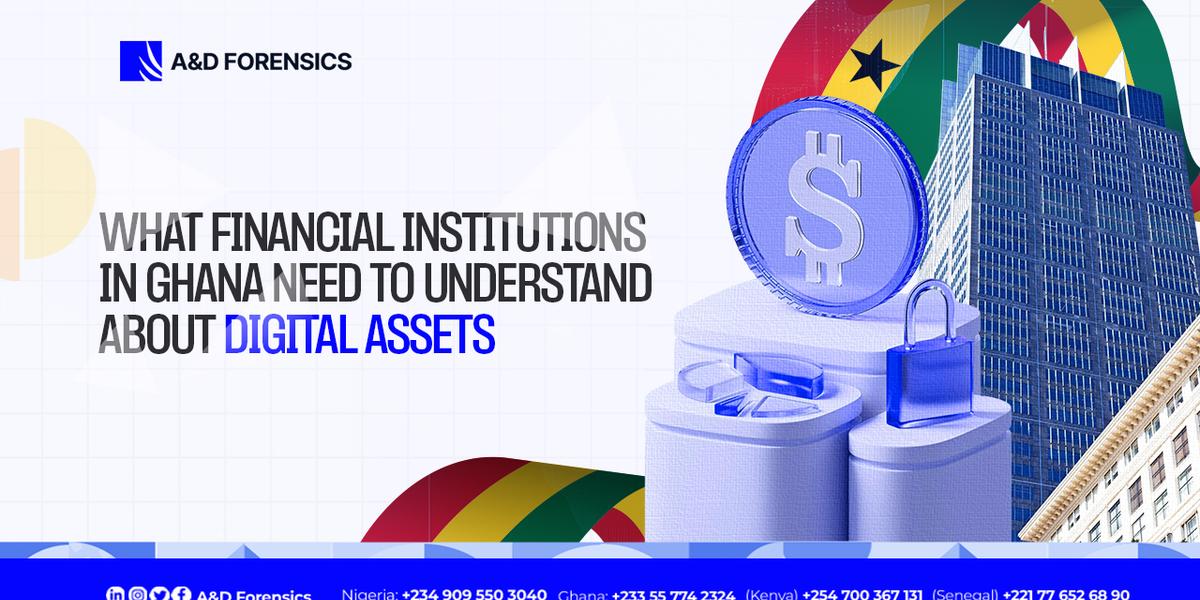

WHAT FINANCIAL INSTITUTIONS IN GHANA NEED TO UNDERSTAND ABOUT DIGITAL ASSETS
Financial institutions in Ghana can no longer treat digital assets as a minor concern. According to the Bank of Ghana's Virtual Assets Department, approximately 3 million Ghanaians representing 17% of the adult population now use cryptocurrencies and digital assets, with crypto activity in Ghana reaching $3 billion in the year ending June 2024.
This level of adoption is now translating into operational exposure for financial institutions. Digital asset activity increasingly intersects with existing banking systems through payments, remittances, and customer-driven transactions, creating visibility gaps in compliance monitoring, risk assessment, and internal controls.
This conversation has taken on greater urgency following a regulatory shift. In December 2025, Ghana's Parliament passed the Virtual Asset Service Providers (VASP) Bill, 2025 (Act 1154), formally legalizing cryptocurrency trading and establishing a comprehensive regulatory framework. Bank of Ghana Governor, Dr. Johnson Asiama announced that "virtual asset trading is now legal. No one will be arrested for engaging in crypto but we now have the framework to manage the risks involved."
Financial institutions in Ghana that understand this early will be in a much stronger position to respond with clarity, while those that treat it as a distant concern may find themselves reacting too late.
A&D Forensics Ghana outlines some critical points on digital assets that financial institutions in Ghana need to know and also pay critical attention to.
Digital assets are already interacting with banks
Many financial institutions in Ghana such as banks assume they are not involved in crypto, but in reality they already are, although not always in a way that is visible or formally recognised within their systems.
This interaction may not necessarily be coming from financial institutions in Ghana offering crypto products directly. Instead, it is being driven by customer behaviour, payment flows, and the increasing overlap between traditional financial services and digital asset platforms. As a result, financial institutions such as Banks in Ghana are already processing, facilitating, or indirectly supporting crypto-related activity, even if they have no formal strategy around it.
This happens through everyday financial activity such as:
- 1.Customers funding crypto accounts via bank transfers
- 2.Proceeds from digital asset trading flowing back into bank accounts
- 3.Payment platforms linking traditional finance with digital asset services
In practical terms, this means financial institutions in Ghana such as banks are already part of the digital asset ecosystem regardless of whether they have consciously positioned themselves there or not.
It is important to pay particular attention to the implication of these interactions because when these interactions are not clearly understood, they create blind spots within compliance and risk management frameworks. Transactions may be processed without sufficient visibility, unusual patterns may go undetected, and institutions may find themselves exposed to risks they have not fully assessed.
According to the 2024 National AML/CFT/CPF Risk Assessment, virtual assets have gained significant traction, particularly in banking and securities, with VASPs offering exchange, wallet management, custody, and transfer services currently operating with little to no regulatory oversight creating exposure for financial institutions in Ghana that serve these customers.
Banks and other financial institutions in Ghana that recognise these interactions early are better positioned to respond. These institutions can assess how these flows move through their systems, strengthen monitoring where necessary, and build internal clarity around how digital asset exposure is being managed.
The real concern in Financial Institutions in Ghana is Exposure
The biggest question for financial institutions today is no longer whether they should adopt digital assets or formally offer crypto-related services, but whether they truly understand their exposure, because even without direct participation, banks are already interacting with digital asset activity through customers, partners, and payment channels as funds move from bank accounts into crypto platforms and back again, while payment providers increasingly act as bridges between traditional finance and digital ecosystems, making these flows quiet, constant, and difficult to ignore.
For financial institutions such as banks in Ghana, understanding exposure requires clarity across three critical areas
- 1.The product level, customer behaviour, transaction patterns, and third-party relationships.
- 2.Understanding the pathways of transactions from bank accounts to fintech platforms to digital asset services and where visibility is lost along the way.
- 3.Understanding what risks are embedded in those flows: Including AML concerns, fraud vectors, sanctions exposure, and reputational implications that may not be immediately obvious.
Without this level of understanding, institutions are not necessarily non-participants but are operating with limited visibility and that is exactly where the real risk lies.
Financial Institutions must, therefore, take the time to map and understand what their exposures are in order to operate in a stronger position. They should be able to respond with clarity, strengthen controls where necessary, and engage confidently with regulators and partners.
What banks and other financial institutions in Ghana gain by understanding digital asset exposure and how they should respond operationally and strategically.
Banks operating in Ghana that take the time to understand digital assets today will be better positioned for what comes next. Institutions that act early will be able to:
- 1.Strengthen internal compliance frameworks in a way that reflects emerging realities
- 2.Equip staff across compliance, risk, and operations teams with practical understanding
- 3.Engage regulators and partners with greater confidence and credibility
- 4.Make informed decisions, rather than reacting under pressure
At the same time, closing the knowledge gap is critical. Understanding how digital asset transactions actually move through financial systems, where exposure points exist, and how risks are embedded within those flows allows institutions to move from passive awareness to active control.
This is where structured support becomes important and firms like A&D Forensics Ghana can play roles in helping institutions to:
- 1.Understand how digital asset activity interacts with their existing systems
- 2.Identify areas of risk and limited visibility
- 3.Build internal awareness across key teams
- 4.Prepare for regulatory expectations before they become mandatory
Ultimately, this approach ensures that institutions are not just aware of digital assets but are also equipped to navigate them with clarity and confidence.
Conclusion
Digital assets are already shaping how money moves today. For Financial institutions in Ghana, the real question is not whether to engage, but how well they understand their exposure and respond to it. Those that move early to build clarity, strengthen internal capacity, and approach the space with confidence will be better positioned to lead.