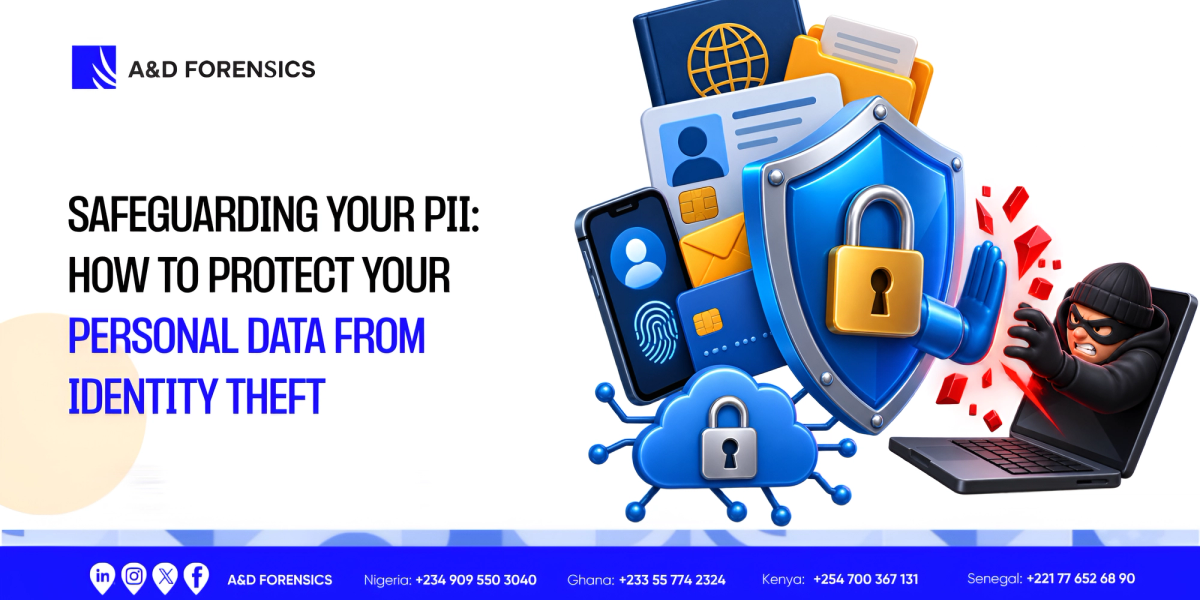
Safeguarding Your PII: How to Protect Your Personal Data from Identity Theft
Personally Identifiable Information (PII) has become one of the most valuable and most attacked assets on the internet.
Every time you sign up for an app, swipe a card, fill a KYC(Know Your Customer) form, or click "accept" on a cookie banner, you hand over a piece of yourself(identity), be it your name, your date of birth, your bank details or your national ID number. Individually, these look harmless but stitched together, they form a complete digital fingerprint that criminals can use to become you, at least on paper. This collection of data is known as Personally Identifiable Information (PII).
What Exactly Is Personally Identifiable Information Personally Identifiable Information (PII)
Personally Identifiable Information (PII) is any data that can be used, either on its own or combined with other data, to identify a specific individual. Security experts typically split it into two tiers; The direct identifiers and indirect identifiers.
Direct identifiers are specific pieces of your personal data that can explicitly pinpoint you on their own, requiring no additional context or information. Because they are data points that are uniquely assigned to you, compromising any one of them creates an immediate, high-severity security risk to you. Primary examples include your full legal name, government-issued identifiers like your national ID Number, Social Security Number, BVN, your driver's license or passport number, and biological data such as your fingerprints.
Indirect identifiers are contextual attributes about you that are typically harmless on their own but become dangerous when combined. While a single detail about you rarely causes harm, fraudsters practice data aggregation, which involves stitching together scattered information like your date of birth, home address, phone number, IP address, employer name, and mother's maiden name to build a complete profile of you. With enough of these combined data points, bad actors can easily pass identity verification checks at financial institutions, bypass your password resets, or fraudulently apply for loans in your name.
Why Identity Theft Problem Is Increasing, Not Reducing
You might think identity theft is old news, something from the era of stolen mail and dumpster diving, However the global data says otherwise. According to IBM's 2026 Cost of a Data Breach Report, customer personally identifiable information (PII) remains the most frequently compromised data type worldwide, appearing in 52% of all breaches, at an average cost of $192 per record. That's the exact information fraudsters need to build a target profile: names, tax IDs, emails, phone numbers, and home addresses.
The global average cost of a data breach has also climbed to a record $4.99 million in 2026, a 12% increase over the previous year. Some sectors carry an even steeper price: healthcare breaches averaged $6.64 million per incident, and financial services breaches averaged $6.29 million, largely due to the fraud and identity theft risks tied to the type of customer data exposed. As breaches grow more expensive for institutions worldwide, the data behind them becomes more valuable to criminals and identity theft keeps pace.
What's changed is how theft happens. It used to be about a hacker breaking into one big database. Increasingly, it's about infostealer malware , small programs quietly installed on individual laptops and phones that harvest saved passwords, browser cookies, and autofill data in real time, then sell that "log" on criminal marketplaces within hours. This means your own device, not just some distant company server, is now a frontline target.
How Identity Theft Actually Happens:
- 1.Data breaches at companies you trust: You can become a victim if a retailer, healthcare provider, or application you use suffers a cyberattack. Compromised corporate databases are now the biggest cause of exposed personal info.
- 2.Phishing and social engineering: Fake emails, texts, or calls designed to trick you into voluntarily handing over information or clicking a malicious link.
- 3.Infostealer malware: Malicious software silently installed via a fake download, cracked software, or malicious ad, which then harvests saved logins, autofill data, and session cookies from your own browser.
- 4.Public Wi-Fi interception: Unsecured networks let attackers on the same network potentially intercept unencrypted traffic.
- 5.Physical theft or "shoulder surfing": Stolen wallets, mail theft, or simply someone watching you type a PIN or password in public.
- 6.Oversharing on social media: Information such as birth date, pet names, school names, and hometowns posted publicly are frequently the exact answers to security questions.
- 7.Insecure IoT and smart devices: Smart cameras, routers, and assistants with weak default passwords can become an entry point into your home network.
How to protect your Personally Identifiable Information
Personally Identifiable Information (PII)No single tool makes you invincible. Real protection comes from layering several habits together, so that if one fails, another catches the problem. Some security habits
- 1.Share less on social media, audit your old posts, and shred sensitive documents like bank statements and pre-approved credit offers before throwing them out.
- 2.Use a password manager for strong, unique passwords, enable two-factor authentication on every account, and update any outdated recovery emails or phone numbers.
- 3.Check your credit report through official bureaus, set up transaction alerts, consider a credit freeze, and use dark web monitoring tools to catch breached credentials early.
- 4.Keep your systems, browser, and apps updated, run antivirus scans regularly, avoid public Wi-Fi (or use a reputable VPN), and change default passwords on routers and smart devices.
- 5.Treat urgency in calls or messages as a red flag and verify independently using a number you already trust before sharing any personal information.
Conclusion
No one can make themselves completely unhackable. The goal is to be a harder, less rewarding target than the next person, and to have a plan ready in case your information ends up in the wrong hands anyway. The organizations holding your data will keep getting breached; that part is out of your control. What is in your control is how much you expose in the first place, how tightly your accounts are locked down, and how fast you catch a problem once it starts. Share less, lock down your accounts, monitor actively, keep your devices updated, and stay skeptical of urgency, layer these five habits together, treat monitoring as routine rather than optional, and identity theft stops being an invisible threat and becomes a risk you're actively managing.
How A&D Forensics Can Help You
Precautions reduce risk, they don't erase it. When PII theft has already happened, especially where money or digital assets are involved, good habits alone won't recover what's lost, you need investigators who can trace what happened and prove it. That's where A&D Forensics comes in.
If you've lost funds through crypto-related fraud, our blockchain forensics team traces stolen funds across digital asset networks and builds evidence-based, court-ready reports, the kind of proof you need to pursue recovery or legal action. If you're responsible for protecting customer data, our AML/CFT compliance audits and penetration testing (VAPT) can help you close the exact gaps that let stolen PII turn into fraud in the first place.