
How AML Experts Use Name Screening to Detect and Prevent Money Laundering
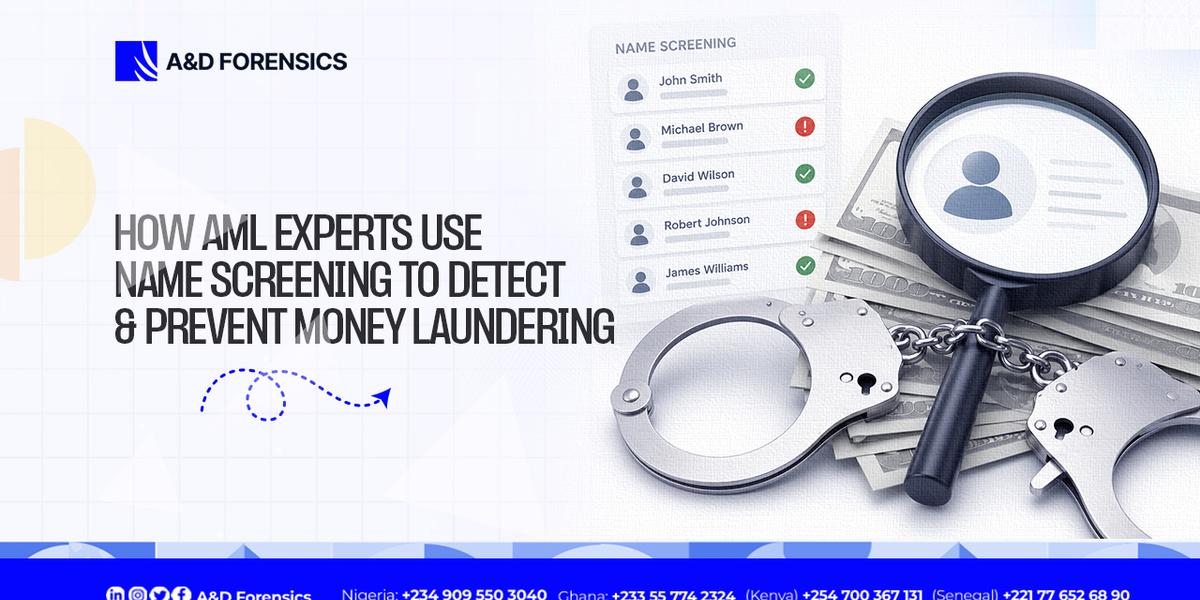
Name Screening is the process of matching an internal record (i.e., customer, counterparty, related account party) against a sanctioned list record, either manually or through an automated screening tool. Name screening may also include batch name screening, which allows a firm to screen its entire customer base using automatic screening tools on a periodic basis.
When onboarding new customers, name screening against sanctions lists is undertaken prior to accepting a new customer relationship, and it is done in real time. Name screening forms a part of entry controls, which give the financial institution more opportunities to collect Simplified Due Diligence (SDD) information.
In simple terms, it is a background check but one built specifically for financial crime. Every time a bank, fintech, or Virtual Asset Service Provider (VASP) onboards a new customer or processes a transaction, name screening AML checks whether that person or business appears on any list that would make the transaction illegal or high-risk.
When done correctly, it is one of the most effective ways to stop money laundering before it starts.
The Techniques Used in Name Screening
Not all names are easy to match. People use aliases, nicknames, and name variations across different countries and languages. That is why AML experts use a combination of techniques to accurately identify and verify individuals across different datasets and reduce the risk of false negatives or false positives.
- 1.Exact Matching compares names character by character to find direct matches on watchlists
- 2.Fuzzy Matching adds flexibility, accounting for spelling variations, abbreviations, and phonetic similarities to reduce false negatives.
- 3.Advanced algorithms take things a step further. They don’t just compare names. They also look at details like location, known aliases, and different name variations to figure out if records point to the same person. By combining all of this information, they make identity matching more accurate and reduce the chances of mistakes.
The Approaches of Name Screening
There are two primary approaches:
- 1.Manual name screening involves searching names in lists and datasets by hand, or using public search engines to look up customer names. It can generate usable risk data but it is limited as search algorithms may deliver inconsistent results, de-prioritise critical information, or be blocked under regional data laws. It is also time-consuming and prone to human error at scale.
- 2.Automated name screening, on the other hand, uses software to scan vast amounts of data in seconds. As Sanctions.io explains, automated screening uses advanced technology to increase efficiency and reduce risks, with AI and machine learning playing a vital role in improving accuracy and adapting to new threats.
For most regulated institutions, regulators now assume that institutions should be using automated systems (not just manual checks) to screen names against watchlists, sanctions lists, and other risk databases.
How AML Experts Use Name Screening Step by Step
The processes are broken into six clear steps:
- 1.Data collection: This is gathering accurate, up-to-date customer identification at onboarding and during periodic reviews.
- 2.Screening setup: This is integrating screening tools with access to both local and global databases.
- 3.Matching: Matching happens using fuzzy matching algorithms to detect name variations and aliases.
- 4.Alert generation: This is where the system flags potential matches for further review.
- 5.Investigation and escalation: This is where compliance teams evaluate alerts to confirm or dismiss risk.
- 6.Documentation and Reporting: This is maintaining records of screening results, decisions, and reports filed for audit and regulatory compliance.
The Challenges in Name Screening AML
Name screening AML is effective, but it also comes with difficulty. The most common challenges include:
- 1.False positives: Common names often trigger alerts that turn out to be genuine customers, not criminals. Too many false positives slow down operations and exhaust compliance teams.
- 2.Language and transliteration: When names are converted from languages like Arabic, Chinese, or Russian into English letters, the spelling can change in different ways because there is no single standard way to write them in English. As a result, the same person’s name can appear with multiple spelling variations across different databases. This becomes a challenge in name screening because systems may not immediately recognize that these different spellings refer to the same individual.
- 3.Aliases and multiple identities: As Sanctions.io notes, sophisticated money launderers often use aliases or similar names to avoid detection, making it harder for screening systems to make accurate connections.
- 4.Data quality: Screening is only as good as the data it runs on. Outdated watchlists or incomplete customer records create blind spots.
Tackling The Challenges of Name Screening
AML Square highlights that advanced AML screening solutions now use AI for KYC to deliver name screening and risk scoring results with high accuracy, while significantly reducing false positives.
Ongoing monitoring not just screening at onboarding is also important. As AML Square further explains, even after a customer has opened an account, AML screening must continue to meet regulatory requirements and detect changes in risk profiles over time.
For institutions that lack the internal capacity to manage this effectively, working with a specialist compliance partner is often the most practical path forward.
Conclusion
Name screening AML is an ongoing process that sits at the heart of any serious financial crime prevention programme. When it works well, it stops criminals from accessing the financial system. When it is poorly implemented, it creates gaps that money launderers are very good at finding.
At A&D Forensics, we help financial institutions, fintechs, and VASPs build compliance frameworks that work under real regulatory scrutiny. Our AML/CFT Compliance services cover sanctions screening guidance, transaction monitoring supervision, and full end-to-end compliance program design that are all aligned with FATF recommendations and African regulatory requirements.
Contributor: Ademola-Adesola Ifeoluwaposimi